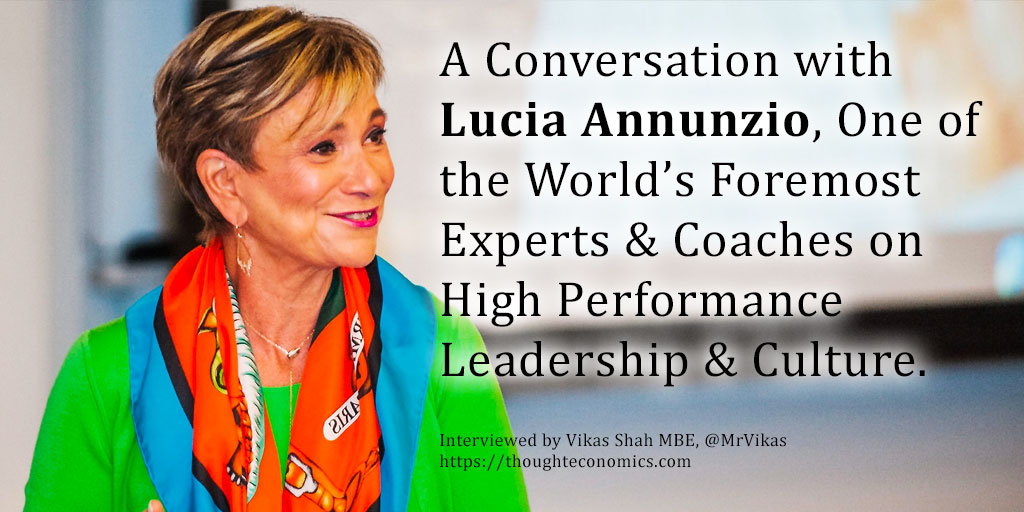
Susan “Lucia” Annunzio is an acclaimed leadership coach, author, President and CEO of the Center for High Performance.
Lucia, known by her clients as the “CEO-Whisperer,” has spent over 25 years observing, analysing, and coaching CEO, C-Suite, and Board dynamics. She has discerned that an organization is only as great as the team that leads it and that there is a direct correlation between the way an organization performs and the way its leadership team functions. Her work is based on CfHP’s proprietary global research on the factors that accelerate or inhibit profitable growth. It achieved critical acclaim and was presented at such prestigious venues as the World Economic Forum and The International Conference on Knowledge, Culture and Change at the University of Greenwich.
Lucia is the author of Contagious Success (Portfolio, 2004), a dynamic, best-selling, management book that revealed the global standard for high performance. Contagious Success was voted Fast Company’s Readers’ Choice. Lucia continued to author two additional prominent business books: Communicoding (Fine, 1990; Penguin USA, 1991) and Evolutionary Leadership (Simon & Schuster, 2001; Fireside, 2002). Lucia is a former Adjunct Professor of Management at the University of Chicago Booth Graduate School of Business, where she is currently part of the Executive Education faculty and teaches the most popular program, High Performance Leadership. She has been a guest lecturer at INSEAD business school in Fontainebleau, France, Kellogg Graduate School of Management, and Instituto De Empresa in Madrid. She also taught at General Electric’s Crotonville Corporate Training Center.
In this interview I speak to Lucia Annunzio, President & CEO of the Center for High Performance. Lucia is one of the world’s foremost experts on high performance culture & leadership and teaches the High Performance Leadership program at Chicago Booth Graduate School of Business.
Q: What is a high-performance environment?
[Lucia Annunzio]: To begin with, I’ll provide a business perspective, followed by what distinguishes it. At its core, a high-performance environment consistently generates profits and fosters innovation. But what truly differentiates it is the approach towards return on investment. Many organizations focus on ROI but overlook the significant expense of human capital on their P&L. In essence, they’re investing in people’s intellectual capacity. Yet, many employees feel they can’t fully utilize their intellect at work. I advocate for the concept of “return on brainpower.” The question is, are you cultivating a space where individuals are encouraged to apply their intellectual prowess? If not, while you might be profitable and innovative, you’re missing out on potential gains. Our research identified the primary factor that drives high performance globally. It wasn’t about budgets, technology, training, or academic qualifications. It was about how valued individuals felt in high-performance settings. They believed they could contribute intellectually, their opinions mattered, and they were given objectives without being micromanaged on the execution. We term this as treating intelligent individuals with the respect their intellect deserves. The antithesis of high performance is micromanagement—dictating every aspect of a task. This approach essentially communicates, “Leave the thinking to me. Just follow orders, and maybe you’ll advance.” It stifles creativity and initiative. I’ve conducted focus groups in 28 countries, and it’s disheartening to see that employees can pinpoint their company’s challenges and offer viable solutions. Yet, they remain silent, fearing repercussions. It’s truly unfortunate.
Q: What are the traits of high-performance leaders?
[Lucia Annunzio]: It might sound unconventional, but after working with esteemed leaders across six continents, I’ve observed that the singular trait they all share is their imperfection. Recognizing and embracing one’s imperfections, while acknowledging that you don’t have all the answers, is the foundation of great leadership. However, it’s equally vital to be acutely aware of your strengths. Understand how your mind operates and identify which aspects of your thinking are the most valuable. Equally important is recognizing your limitations and surrounding yourself with individuals who excel in areas you might not. This creates an environment that thrives on collective intelligence, where the combined efforts surpass individual contributions.
To foster such an environment, there are three fundamental, yet challenging skills leaders must possess:
Active Listening: It’s not just about echoing what’s being said. True listening involves comprehending the essence of the message. Often, our minds are preoccupied, making us focus on potential flaws in the conversation rather than the actual content.
Observational Listening: This involves paying attention to non-verbal cues. While maintaining eye contact can be challenging in virtual settings like Zoom, it’s crucial to be attentive to body language. It’s also essential to be fully present during interactions, avoiding distractions like checking phones.
Empathetic Listening: Empathy isn’t just a desirable leadership trait; it’s indispensable. The current times have seen unprecedented levels of anxiety, stress, and mental health challenges. The workforce is grappling with diminished innovation and concentration capacities. As leaders, it’s imperative to acknowledge that these challenges affect everyone, including ourselves. By sharing our experiences and supporting one another, we can navigate these trying times more effectively. Emotional turmoil hinders clear thinking. While we might believe we’re being productive, we’re often just going through the motions, repeating familiar tasks.
In essence, true leadership is about understanding, empathy, and collaboration.
Q: What is the role of peer mentors in high performance environments?
[Lucia Annunzio]: Simon Sinek aptly said that leadership isn’t about being in charge; it’s about caring for those under your charge. The essence of leadership is nurturing and supporting your team. The environment at work directly influences how individuals interact with their families. If someone has endured a challenging day, feeling undervalued or overshadowed by their superiors, they’re likely to carry that negativity home. Such days can strain personal relationships, making one less inclined to engage with their loved ones. On the contrary, when treated with respect, empathy, and genuine listening—even if their suggestions aren’t always implemented—they return home with a positive demeanour.
However, a leader’s well-being is paramount. Current statistics indicate that 1 in 3 managers grapple with exhaustion, stress, and mental health challenges. If leaders themselves are struggling, how can they effectively support their teams? It’s crucial for leaders to prioritize self-care. This encompasses regular exercise—not just for physical fitness but to boost endorphins and maintain energy levels—along with ensuring adequate downtime, leisure, and moments of joy.
Q: Are you seeing a lot of generational change in attitude too?
[Lucia Annunzio]: As a baby boomer myself, I must admit that our generation often fell short in setting the right leadership example. We leaned heavily into a leadership style characterized by micromanagement, emphasizing the principles of ‘know, tell, and command.’ Many looked up to this model, and unfortunately, emulated it. But was it truly effective? Did it not contribute to the financial crisis of 2008? While the crisis itself is remembered, the leadership failures leading up to it often aren’t. Many leaders at the time overlooked the insights of their teams, held unwavering beliefs in the invincibility of the real estate market, and displayed a level of arrogance centered around profit. This mindset adversely affected countless lives, except, notably, their own.
So, what lessons have the emerging leaders absorbed from this? This is where my optimism lies. The new generation of leaders, now in their 40s, inspires hope. They’ve experienced the toxicity of past leadership styles and are eager for change. While they harbor aspirations of fostering enjoyable and positive work environments, they’re often uncertain about the path forward. Yet, their determination to deviate from past mistakes and genuinely make a difference is commendable. It’s this very spirit that fuels my passion for teaching and willingness to travel globally to impart knowledge. They represent hope for a brighter leadership future.
Q: How is working-remotely changing high performance environments?
[Lucia Annunzio]: Many assume that the appeal of remote work lies in the comforts it offers, like wearing casual attire or avoiding daily commutes and makeup routines. While there’s some truth to this, the deeper realization for many was the escape from toxic work environments. Once at home, they felt liberated and could finally breathe. Whether consciously or subconsciously, the aversion to returning to such environments is strong. It’s only natural for individuals to prefer healthier spaces over toxic ones. While they’ve found solace at home, the camaraderie of the workplace is undoubtedly missed. Social connections are vital, and replicating them on platforms like Zoom is challenging. Efforts like virtual coffee breaks, weekly questions, or Zoom happy hours are commendable, but they can’t replace face-to-face interactions. Occasional in-person meetings, perhaps quarterly, are essential. After all, people work for people, and without personal interactions, something vital is lost.
Our research indicates that high performance isn’t just about productivity; it’s a combination of productivity and creativity in environments that foster learning and experimentation. Such dynamics, where individuals learn from each other and their mistakes, are tough to emulate in virtual settings. While I’m often labeled an innovator—and I pride myself on being a tech-savvy baby boomer—replicating these dynamics digitally is a challenge I’ve grappled with. If a fully remote setup is unavoidable, periodic in-person meetings are crucial. As a leader, understanding your team’s challenges without ever meeting them is nearly impossible.
We’re fortunate to be in an era of workforce diversity, which is immensely beneficial. However, with diversity comes the challenge of understanding varied backgrounds and perspectives. Even if two individuals grew up nearby, their personal experiences could be worlds apart. We often make assumptions about behaviors, many of which are misguided. Without personal interactions, it’s all too easy to misinterpret or misconstrue intentions.
Q: Are you seeing a generational difference in resilience in the workplace?
[Lucia Annunzio]: Many often overlook the profound impact of the younger generation missing two crucial years of their education. Consider the new graduates who lost two years of university experience or high school students who missed pivotal moments in their junior and senior years. These individuals were deprived of essential social skills that are foundational for workplace success. Now, as we beckon Gen Z to return to offices, we must recognize that they’re not receiving the mentorship and leadership development crucial for their growth. Their perceived lack of communication skills stems from a heavy reliance on technology during their formative years.
As leaders, our role isn’t to judge or label but to empathize and understand. Imagine navigating two years of university without forming friendships, attending parties, or experiencing typical college life. This generation has faced unique challenges, from cyberbullying to unwanted exposure on platforms like TikTok. They’ve encountered pain early on, and when they step into the workplace, they’re often ill-equipped to manage these emotions. Contrary to some opinions, these young individuals are not just vulnerable; they’re intelligent, and their potential is immense.
They are the digital natives, the innovators of tomorrow, and they have much to offer if we guide them. The collaboration between generations is vital. While I might have social skills and a decent grasp of technology for my age, I acknowledge the vast digital expertise of the younger generation. They’ve grown up in a world seamlessly integrated with technology, and their insights are invaluable, especially in an era dominated by AI. While AI offers tremendous capabilities, it lacks creativity, empathy, and the human touch. We need digital natives to harness this technology effectively, ensuring it complements human creativity and empathy.
So, the question remains: How do we support these young talents to ensure they, in turn, bolster our companies?
Q: How do we measure productivity in a high-performance environment?
[Lucia Annunzio]: To achieve high performance, innovation is paramount. However, innovation isn’t just about refining processes to be more efficient or leveraging technology. While such advancements were game-changers in the 90s, we’re now in 2023, and the landscape has evolved. True innovation today involves introducing new products, services, and exploring untapped markets. This kind of innovation requires not just encouragement but also appropriate measurement.
Yet, there’s a challenge, especially for publicly traded companies in North America. The pressure of delivering impressive quarterly results often hampers long-term innovative pursuits. Genuine innovation isn’t an overnight achievement; it involves experimentation, learning from failures, and iterating. Consider Thomas Edison: it took him 1000 attempts to perfect the lightbulb. Had he been under the constraints of modern-day quarterly expectations, we might still be in the dark. Our current system, which emphasizes short-term results, inadvertently stifles innovation.
Here’s an amusing anecdote to illustrate this point: One of my students mentioned their company’s “most successful failure award.” It’s a brilliant concept, highlighting that even well-researched and calculated ventures can fail. That’s the essence of risk – it’s never a guaranteed success. If there’s a certainty of success, then it’s not truly innovative, as there’s no risk involved. Yet, our current corporate culture often shies away from taking risks. We’re more focused on quantifiable outputs, like the number of products produced or sales closed, rather than understanding the broader implications and costs associated with these numbers. We need to shift from merely counting outputs to understanding the holistic impact of our actions.
Reflect on this: Why was Steve Jobs ousted from Apple? He envisioned investing more in the Mac, which, at its inception, wasn’t an immediate success. True innovation often faces initial hurdles. So, when will corporations muster the courage to defy the investment community’s short-term expectations and foster environments that prioritize creativity and long-term vision? I eagerly await that era and remain optimistic.
To the leaders in their 40s and early 50s occupying senior roles: I urge you to cultivate a culture that dares to challenge established norms. Take inspiration from figures like John Browne of BP. He never hesitated to confront the status quo or the investment community, even if it meant short-term losses for long-term gains. Under his leadership, BP thrived.
Q: How do high performance teams make decisions?
[Lucia Annunzio]: High-performance teams, in my view, assemble the brightest minds, gather all available data, and then make informed decisions. These decisions, even if made with the best intentions, might sometimes be off the mark. But it’s the ability to learn from these missteps that truly defines a high-performance team.
I hope you’re emphasizing to your MBA students that while many pursue this degree with aspirations of financial success, which is entirely valid, there will come moments in their careers where they’ll face a crossroads between ambition and integrity. What will they choose? If the goal is to build enduring companies and contribute positively to the world, they must recognize the broader social responsibilities of leadership, not just the financial ones.
It’s essential to identify and document one’s core values. Keep them close, perhaps even in your pocket, because there will be instances where you’ll be tempted to compromise. Maybe it’s a minor alteration on a balance sheet or a product that’s not entirely up to standard. In such moments, if you’re not grounded in your values, it’s easy to rationalize these decisions. But every small compromise can lead to a cascade of justifications, eroding your moral compass over time. Fast forward a few decades, and you might find yourself reflecting on your choices, questioning your identity, and grappling with regret.
Q: What does legacy mean to you?
[Lucia Annunzio]: My guiding principle has always been consistent: to positively influence the lives of individuals globally through my work. I gauge my accomplishments by considering the potential impact of each endeavour, whether it’s accepting an assignment, teaching a class, or appearing on a program like yours. Every decision aligns with my core mission: to advocate for senior leaders to treat their teams with respect and dignity. This approach isn’t just morally right; it’s also fiscally and ethically sound. By influencing these leaders, I can touch the lives of countless employees worldwide. As I’ve mentioned before, enhancing someone’s work environment invariably improves their personal life, a ripple effect that I hold dear. People often ask if the constant travel wears me out. On the contrary, the opportunity to make a meaningful difference invigorates me.
 What an honor to be featured in The University of Chicago Booth publication “Booth Stories,” and to share my tips for creating a positive high-performance culture! It means a great deal to me personally and professionally that two of my former students, Gretchen Holloway, senior vice president and CFO of ITC Holdings, and Tim Moormeier, president of U.S. Engineering, shared what they learned from my High Performance Leadership class at Booth.